
5 Marketing Metrics Small Law Firms Should Review Monthly
What Is Customer Acquisition Cost and Why It Matters for Law Firms
Running a small law firm means every marketing dollar has to work. Yet many firms spend on ads, content, and referral programs without a clear picture of what each new client actually costs — or whether that spend is sustainable.
Customer acquisition cost marketing — the discipline of tracking, calculating, and optimizing what you pay to bring in each new client — is one of the most actionable frameworks a small law firm can adopt. When you know your numbers, you can make smarter decisions about where to invest, what to cut, and how to grow.
Key Takeaways
- Customer acquisition cost (CAC) is the total marketing and sales spend divided by the number of new clients gained in a given period.
- Small law firms should review at least five core marketing metrics every month to catch problems early.
- A healthy CAC varies by practice area and market, but it should always be significantly lower than the average client lifetime value.
- When metrics are off, a structured diagnostic process — not reactive spending — is the right response.
- Monthly reviews do not require expensive software; a consistent spreadsheet process can be highly effective.
Customer acquisition cost (CAC) is the total amount a firm spends on marketing and sales activities divided by the number of new clients acquired during the same period. For law firms, this metric connects marketing investment directly to revenue-generating outcomes, making it one of the clearest indicators of marketing efficiency.
Many small law firms track activity — impressions, clicks, social posts published — without tracking outcomes. CAC shifts the focus from activity to results. It answers the question that actually matters: how much did it cost to get a paying client through the door?
Understanding CAC also creates a foundation for evaluating other metrics. Conversion rates, lead source performance, and website engagement all become more meaningful when viewed alongside acquisition cost.
The Five Core Marketing Metrics to Review Monthly
The five metrics every small law firm should review monthly are: (1) customer acquisition cost, (2) lead-to-client conversion rate, (3) cost per lead by channel, (4) website engagement and lead capture performance, and (5) client lifetime value relative to CAC. Together, these metrics give a complete picture of marketing health.
1. Customer Acquisition Cost (CAC)
CAC is your north-star metric. It tells you whether your marketing spend is proportionate to the clients you are gaining. Track it monthly so you can spot upward trends before they become budget problems.
2. Lead-to-Client Conversion Rate
Conversion rate measures the percentage of leads — inquiries, consultations scheduled, or contact form submissions — that become retained clients. A declining conversion rate often signals an intake problem rather than a marketing problem, which changes the corrective action entirely.
3. Cost Per Lead by Channel
Not all leads cost the same. Paid search leads may cost significantly more per inquiry than organic search or referral leads. Tracking cost per lead by channel lets you allocate budget toward the channels delivering the most cost-efficient volume.
4. Website Engagement and Lead Capture Performance
Website metrics — including pages per session, time on page, bounce rate, and contact form completion rate — indicate whether your site is converting visitors into inquiries. A high-traffic site with a low contact rate is a conversion problem, not a traffic problem.
5. Client Lifetime Value (CLV) Relative to CAC
Client lifetime value (CLV) is the estimated total revenue a client generates over the course of their relationship with your firm. The ratio of CLV to CAC is one of the most important sustainability indicators in law firm marketing. A ratio below 3:1 is generally considered a warning sign across service businesses, though the appropriate benchmark varies by practice area.
Reviewing these five metrics together each month gives small law firms an early-warning system for marketing inefficiency.
How to Calculate Customer Acquisition Cost for Your Firm
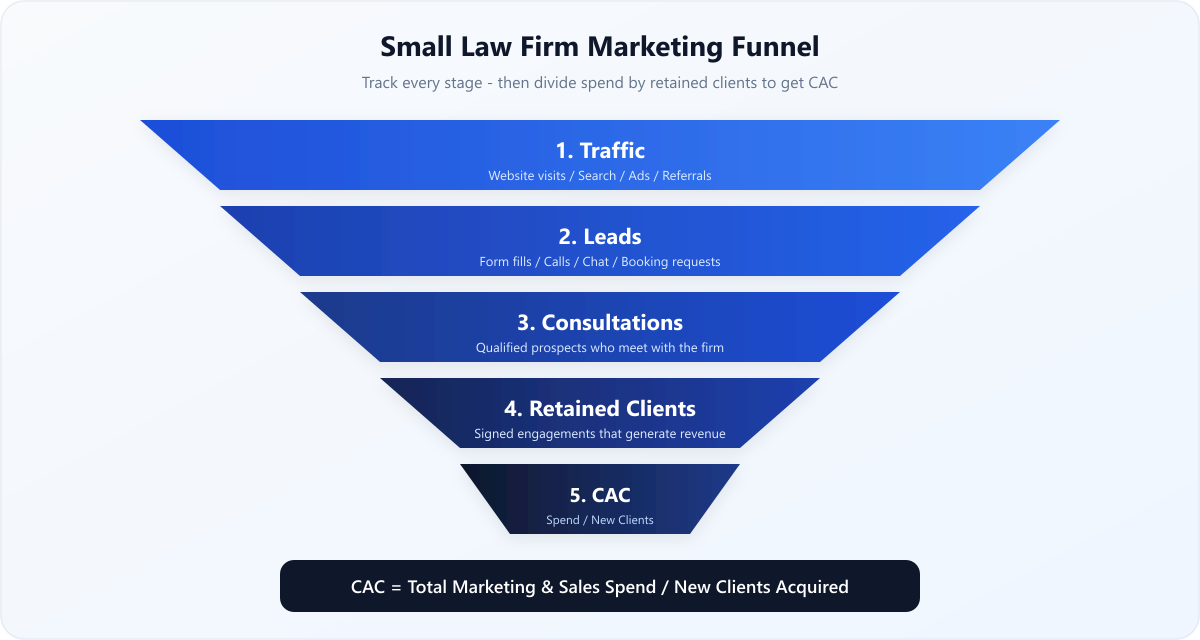
To calculate CAC, divide your total marketing and sales spend for a given period by the number of new clients acquired in that same period. The formula is: CAC = Total Marketing and Sales Spend ÷ Number of New Clients Acquired.
What to Include in Your Spend Calculation
Many firms undercount their true CAC by omitting non-obvious costs. A complete spend calculation should include:
- Paid advertising spend (search, social, display)
- Agency or consultant fees
- Content creation and SEO costs
- Sponsorships, directories, and listing fees
- Staff time allocated to marketing activities (estimated at hourly rate)
- Software and tools used for marketing
A Practical Example
If a firm spends $4,000 per month on all marketing activities and acquires 8 new clients that month, the CAC is $500 per client. Whether $500 is acceptable depends on the average fee per client and the practice area — a $500 CAC is sustainable for an estate planning firm averaging $3,000 per matter; it may be less sustainable for a firm handling low-fee traffic matters.
Tracking Period Consistency
Use the same time period for spend and client acquisition. Mismatched periods — for example, counting spend from one month but clients who converted from leads generated two months prior — distort the calculation. Many firms use a rolling 30-day window or align tracking to calendar months.
Once you have a consistent CAC calculation, you have a baseline to measure improvement against.
What Healthy CAC and Conversion Rates Look Like for Law Firms
Healthy CAC benchmarks vary meaningfully by practice area, market size, and firm stage. There is no universal number, but the relationship between CAC and client value is the key indicator of sustainability.
General Benchmarks to Consider
Published benchmarks for law firm CAC are limited and vary by source. The following general patterns are commonly observed in legal marketing discussions. Many state bar associations publish law practice management resources that address marketing budgeting and business development; firms are encouraged to consult their own state bar's law practice management advisors for jurisdiction-specific guidance. The American Bar Association's Law Practice Division also publishes resources on law firm business management that may be useful as a reference point.
- Personal injury firms often operate with higher CAC figures because contingency matters carry higher potential revenue per case.
- Family law and estate planning firms typically target lower CAC figures because average matter fees are more predictable and moderate.
- Business law and transactional firms may have higher CLV due to repeat engagements, which can justify a higher upfront CAC.
A CLV-to-CAC ratio of 3:1 or higher is a widely cited benchmark across professional services. Below 2:1 suggests marketing spend may be outpacing returns.
Conversion Rate Expectations
Conversion rate from consultation to retained client varies by practice area and intake process. Firms with structured intake processes and prompt follow-up tend to see higher conversion rates. A conversion rate below 20% from consultation to retained client is often a signal worth investigating, though context matters significantly.
These benchmarks are reference points, not guarantees. Your firm's specific economics should drive your targets.
Thinking about your firm's marketing numbers? Understanding where your acquisition costs stand is a practical first step. A marketing review conversation can help clarify what your current metrics mean for your firm's growth strategy.
When Your Metrics Are Off: Diagnostic Steps and Corrective Actions
When a marketing metric moves in the wrong direction, the first step is diagnosis — not reactive spending. Most metric problems trace back to one of three root causes: a traffic problem, a conversion problem, or a cost structure problem.
Step 1: Identify Which Metric Is Off and by How Much
A single bad month may be noise. Two or three consecutive months of decline in the same metric is a trend. Establish a threshold — for example, a 15% increase in CAC or a 10-point drop in conversion rate — that triggers a formal review.
Step 2: Trace the Problem to Its Source
Work backward through the funnel:
- If lead volume is down, the problem is likely traffic or visibility (SEO, paid ads, referral activity).
- If lead volume is stable but conversion is down, the problem is likely intake, follow-up speed, or consultation quality.
- If lead volume and conversion are stable but CAC is rising, the problem is likely cost structure — spending more per lead without improving volume or conversion.
Step 3: Apply a Targeted Corrective Action
Match the fix to the diagnosis:
- Traffic problem: Audit SEO performance, review paid campaign targeting, or re-engage referral sources.
- Conversion problem: Audit intake response time, review consultation scripts, or add a structured follow-up sequence.
- Cost structure problem: Pause underperforming channels, renegotiate vendor contracts, or reallocate budget toward lower-cost channels.
Step 4: Measure the Impact Before Expanding the Fix
Avoid changing multiple variables simultaneously. Adjust one element, measure for 30 to 60 days, then evaluate before making additional changes. This keeps your data interpretable.
Diagnostic discipline prevents firms from spending their way out of problems that spending cannot solve.
Building a Monthly Metrics Review Process
A monthly metrics review does not need to be complex. A consistent, documented process is more valuable than a sophisticated one that does not get done.
What a Monthly Review Should Include
- Pull data from all active marketing channels (Google Ads, organic search, social, directories, referrals).
- Calculate CAC, cost per lead by channel, and conversion rate for the month.
- Compare to the prior month and the same month in the prior year if data is available.
- Flag any metric that has moved beyond your defined threshold.
- Document one or two action items with owners and deadlines.
Tools That Support the Process
Many small firms manage this process effectively with a combination of:
- Google Analytics 4 for website and traffic data
- A CRM or intake tracker (even a structured spreadsheet) for lead and conversion data
- Ad platform dashboards for paid channel spend and lead volume
- A simple monthly reporting template that consolidates all five metrics in one view
Who Should Own the Review
In small firms, the managing partner or a designated administrator typically owns the monthly review. If a marketing agency or consultant is engaged, they should deliver a monthly report that maps to these five metrics — not just activity metrics like impressions or clicks.
Consistency over time is what makes monthly reviews valuable. A year of monthly data reveals patterns that a single month cannot.
People Also Ask
What are the most important marketing metrics for law firms?
The most important marketing metrics for law firms are customer acquisition cost, lead-to-client conversion rate, cost per lead by channel, website lead capture performance, and client lifetime value relative to CAC. These five metrics connect marketing activity to business outcomes.
How do you measure law firm marketing success?
Law firm marketing success is measured by whether marketing spend generates retained clients at a cost that is sustainable relative to client value. Activity metrics like impressions and clicks are secondary; outcome metrics like CAC and conversion rate are primary.
What marketing KPIs should small law firms track?
Small law firms should track customer acquisition cost, cost per lead by channel, consultation-to-client conversion rate, website contact form completion rate, and CLV-to-CAC ratio. These KPIs are actionable and directly tied to firm revenue.
How often should law firms review marketing metrics?
Law firms should review core marketing metrics monthly. Monthly reviews are frequent enough to catch trends early and infrequent enough to allow meaningful data to accumulate. Quarterly reviews alone are often too slow to catch problems before they become costly.
What does a good law firm conversion rate look like?
A good law firm conversion rate from consultation to retained client varies by practice area, but many firms target 30% or higher from scheduled consultations. Rates below 20% often indicate an intake or follow-up issue worth investigating.
How to improve law firm client acquisition cost?
To improve client acquisition cost, identify your lowest-cost lead sources and allocate more budget there, audit and improve your intake conversion process to get more value from existing leads, and eliminate or renegotiate spend on channels with consistently high cost per acquired client.
What is a healthy law firm marketing ROI?
A healthy law firm marketing ROI is generally considered to be a CLV-to-CAC ratio of 3:1 or higher — meaning each client generates at least three times what it cost to acquire them. The appropriate ratio varies by practice area and firm economics.
How do you measure law firm website performance?
Law firm website performance is measured by traffic volume by source, bounce rate, pages per session, time on page, and — most importantly — contact form completion rate and consultation requests generated. Traffic without conversions indicates a website content or UX problem.
What metrics indicate poor law firm marketing performance?
Poor law firm marketing performance is indicated by rising CAC without a corresponding increase in client value, declining conversion rates from lead to retained client, high cost per lead with low lead quality, and a CLV-to-CAC ratio below 2:1 over multiple months.
How to track law firm lead quality and sources?
Track lead quality and sources by asking every new inquiry how they found your firm, recording that information in a CRM or intake log, and then tracking which sources produce retained clients — not just inquiries. Source-to-client conversion rate is more meaningful than source-to-lead volume alone.
How Our Firm Helps Small Law Firms Optimize Acquisition Cost and Marketing Performance
Understanding your marketing metrics is the foundation of sustainable firm growth. When you know what each client costs to acquire, which channels are delivering value, and where your conversion process breaks down, you can make decisions based on evidence rather than assumption.
Our firm works with small law firms to bring clarity to their marketing numbers and connect those numbers to practical strategy. If your metrics are unclear, inconsistent, or pointing in the wrong direction, a conversation about your current marketing approach can help identify where to focus.
This content is informational in nature. If you are evaluating your firm's marketing strategy and want to understand how these metrics apply to your specific situation, we encourage you to reach out for a direct conversation.
Sources & References
- Small Business Administration (SBA) — Market Research and Competitive Analysis — https://www.sba.gov/business-guide/plan-your-business/market-research-competitive-analysis — Accessed June 2025
- American Bar Association Law Practice Division — Law Practice Management Resources — https://www.americanbar.org/groups/law_practice/ — Accessed June 2025
- Federal Trade Commission (FTC) — Marketing Basics for Small Businesses — https://www.ftc.gov/business-guidance/small-businesses — Accessed June 2025
- Google — Google Analytics Help Center: Measure and Optimize Your Marketing — https://support.google.com/analytics — Accessed June 2025
This content is for informational purposes only and does not constitute legal advice.
Informational Purposes Only — The content on this page is provided for general informational and educational purposes only. It does not constitute legal advice, and reading it does not create an attorney-client relationship between you and LexPair or any attorney. Laws vary by state and change frequently. The information here may not reflect the most current legal developments. Do not act or refrain from acting based on anything you read on this page without first seeking the advice of a licensed attorney in your jurisdiction. If you believe the information on this page is inaccurate or outdated, please contact us so we can review and correct it promptly.
For full details, see LexPair's Editorial Policy and Terms of Use.
Connect With an Attorney — Every legal situation is unique. If you're dealing with The 5 Marketing Metrics Every Small Law Firm Should Review Monthly (And What to Do When They're Off), speaking with an experienced legal attorney can help you understand your options. Find a qualified attorney near you on LexPair — it's free to get started.