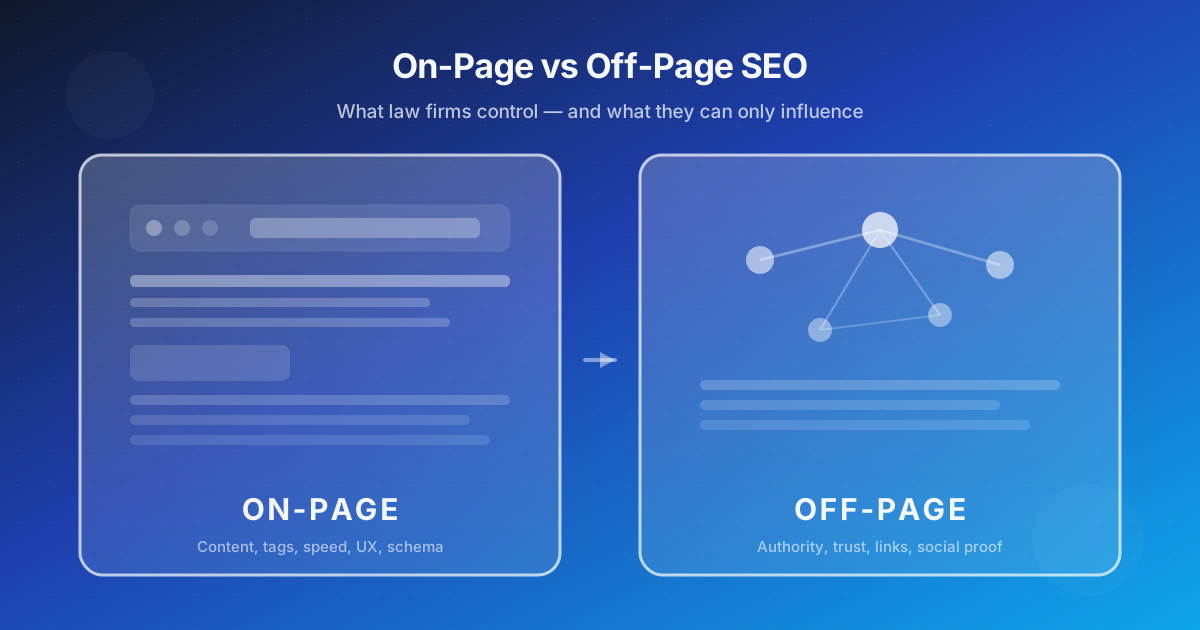
SEO breaks down into two categories: the things you can control on your own website and the things that happen outside of it. Here's what each one means for your firm and where to focus your energy.
SEO is not one thing
Most attorneys hear "you need better SEO" and treat it as a single to-do item. In reality, SEO splits into two very different categories, and understanding the distinction changes how you spend your time and budget.
On-page SEO is everything that happens on your website — the parts you directly control. Off-page SEO is everything that happens elsewhere on the internet — the parts that are largely out of your hands.
Both matter. But they require completely different approaches, and most law firms are neglecting one while over-investing in the other. Let's break down what each one actually involves.
On-page SEO: The things you control
Think of on-page SEO as your firm's home court. Every element on your website that influences whether Google understands, trusts, and ranks your pages falls under this umbrella. The good news is that every single one of these factors is within your power to improve.
Website content
This is the most important on-page factor, and it is the one most law firms get wrong. Your service pages, practice area descriptions, attorney bios, and blog posts are not just for prospective clients — they are the primary material Google uses to decide what your firm is an authority on and which searches it should appear for.
Content that works for SEO is not about stuffing keywords into paragraphs. It is about clearly and thoroughly answering the questions your prospective clients are actually asking. A family law firm that publishes a detailed, plainly written guide on "How Child Custody Decisions Are Made in Texas" is doing more for its rankings than one paying for generic blog posts about "the importance of hiring a lawyer."
Headlines and title tags
Every page on your website has a title tag — the text that appears in the browser tab and, more importantly, in Google search results as the clickable blue link. If your title tags are vague ("Home" or "Services") or duplicated across pages, you are leaving rankings on the table.
A strong title tag is specific and descriptive. "Dallas Personal Injury Attorney | Free Consultation | Smith Law" tells both Google and prospective clients exactly what the page is about and why they should click.
Headlines within the page matter too. The heading structure (H1, H2, H3) helps Google understand how your content is organized and which topics are most important. Think of headings like an outline: they should tell the story of the page even if someone only reads the bold text.
Images and ALT text
Every image on your website is an opportunity — or a missed one. Google cannot "see" images the way humans can. It relies on ALT text, a short description attached to each image, to understand what the image contains.
If your website has dozens of images with no ALT text, or with generic labels like "IMG_4023.jpg," Google learns nothing from them. But if your team photo has ALT text that reads "Smith and Associates attorneys in their Dallas office," it reinforces your location and your brand for search engines.
Meta descriptions
The meta description is the short paragraph that appears under your title tag in Google search results. It does not directly affect rankings, but it heavily influences whether someone clicks on your result or scrolls past it.
A compelling meta description for a law firm reads like a one-sentence pitch: "Experienced Houston DWI defense attorneys. Over 2,000 cases handled. Free case evaluation — call today." Compare that to a page with no meta description at all, where Google pulls a random sentence from your page that may or may not make sense out of context.
Structured data
Structured data is code added to your website that helps Google understand the content in a more precise way. For law firms, the most valuable types are LocalBusiness markup (which tells Google your name, address, phone number, and hours), FAQ markup (which can get your questions displayed directly in search results), and Attorney markup (which identifies specific lawyers and their credentials).
You do not need to understand the code yourself. What matters is knowing that it exists and asking whoever manages your website whether it is in place. Firms with proper structured data consistently appear in richer, more prominent search results.
Page speed
If your website takes more than three seconds to load, roughly half of your visitors will leave before seeing a single word. Google knows this and factors page speed into its rankings.
Common culprits are oversized images, outdated website platforms, too many third-party scripts (chat widgets, tracking pixels, pop-ups), and cheap hosting. A fast website is not a luxury. It is a ranking factor, a conversion factor, and the first impression your firm makes.
User experience
Google pays attention to how visitors behave on your website. If people land on your page and immediately hit the back button, that signals to Google that your page did not satisfy their search. If they stay, scroll, and click through to other pages, it signals relevance and quality.
User experience includes navigation (can visitors find what they need in two clicks?), mobile responsiveness (does the site work properly on a phone?), readability (is the text large enough and the layout clean?), and clear calls to action (does the visitor know what to do next?).
Off-page SEO: The things you don't control
Off-page SEO is everything that happens outside of your website that influences how Google perceives your firm. You cannot directly control these factors the way you can edit a title tag or rewrite a service page, but you can influence them through deliberate strategy.
Domain authority
Domain authority is a score that estimates how likely your website is to rank in search results, based largely on the quality and quantity of other websites linking to yours. A brand-new website starts with very little authority. A well-established firm with years of press coverage, directory listings, and mentions across the legal web has built significant authority over time.
You cannot buy domain authority outright. It is earned through the cumulative effect of everything else in the off-page category.
Trustworthiness
Google evaluates whether your firm is a legitimate, credible entity. Consistent business information across the web, positive reviews, mentions in reputable publications, and a clean online history all contribute to this. Trustworthiness is not a single metric — it is the overall impression your digital footprint creates.
Social signals
While social media activity is not a direct ranking factor, it contributes to off-page SEO indirectly. Attorneys and firms that are active on LinkedIn, share content that gets engaged with, and build a visible professional presence generate signals that reinforce brand authority. Content that gets shared widely also creates opportunities for the most important off-page factor of all.
Backlinks: The single biggest off-page factor
A backlink is simply a link from another website to yours. When a reputable website links to your firm's page, it acts as a vote of confidence in Google's eyes. The more quality votes you have, the higher Google's trust in your site.
Not all backlinks are equal. A link from a major legal publication or your local bar association carries far more weight than a link from an obscure, unrelated blog. Quality matters more than quantity.
There are three main types of backlinks, and understanding them will help you build a smarter strategy.
Natural links are the gold standard. These happen when someone links to your content without you asking. A legal journalist references your firm's analysis of a recent court ruling. A financial advisor links to your estate planning guide as a resource for their clients. A local news outlet mentions your firm in a story. These links carry the most weight because they are genuine endorsements, not transactional exchanges.
The best way to earn natural links is to publish content worth linking to. Original research, definitive practice area guides, commentary on local legal developments — these are the types of pages that attract links organically.
Manually built links are earned through outreach and relationship-building. This is where you actively work to get your firm linked from other websites.
Common approaches include:
- Guest contributions. Writing an article for a legal publication, business journal, or industry blog that includes a link back to your firm.
- Resource outreach. Identifying websites that are writing about a topic you have covered extensively, reaching out, and letting them know you have a comprehensive resource they might want to reference. For example, if a financial planning blog discusses the basics of power of attorney and you have a detailed guide on the topic, a brief, professional email can result in a valuable link.
- Professional associations and partnerships. Many bar associations, legal networks, and referral partners will link to member firms. These carry strong trust signals because of the authority of the linking organization.
Self-created links are ones you place yourself. These include directory listings (Avvo, FindLaw, Justia, your local chamber of commerce), social media profiles, and legal association member pages. Every firm should claim and complete these profiles because they serve double duty: they create backlinks and they ensure your business information is consistent across the web, which supports both SEO and GEO.
A word of caution on backlinks
There is a right way and a wrong way to build links. Legitimate link building — publishing great content, contributing to reputable publications, maintaining accurate directory profiles — is exactly what Google wants to see.
But there are shortcuts that will hurt your firm. Creating multiple fake websites for the sole purpose of linking back to your main site, buying bulk links from overseas link farms, or participating in link exchange schemes are all considered black hat SEO. Google's algorithms are sophisticated enough to detect these tactics, and the penalty is severe: your site can be demoted in rankings or removed from search results entirely.
For a law firm, the reputational risk alone should be disqualifying. The firms that build lasting search authority do it the same way they build lasting client relationships — through credibility, consistency, and genuine value.
How on-page and off-page SEO work together
On-page SEO makes your website worth visiting. Off-page SEO makes Google confident enough to send visitors your way.
A firm with exceptional content but no backlinks will struggle to rank because Google has no external validation that the content is trustworthy. A firm with strong backlinks but a slow, poorly organized website will rank briefly and then fall as visitors bounce away.
The firms that consistently appear at the top of search results have both: a technically sound, content-rich website and a growing portfolio of natural, high-quality links pointing to it.
| On-Page SEO | Off-Page SEO | |
|---|---|---|
| Where it happens | On your website | Across the rest of the internet |
| Level of control | Full control | Influence, not control |
| Key factors | Content, title tags, meta descriptions, images, page speed, user experience, structured data | Backlinks, domain authority, trustworthiness, social signals |
| How to improve | Edit and optimize your own pages | Publish linkable content, build relationships, maintain directory profiles |
| Timeline | Changes can take effect in days to weeks | Authority builds over months to years |
Where most law firms should start
If your firm has not done a structured SEO review recently, start with on-page. It is where you have the most control and where improvements show results fastest.
- Review your title tags and meta descriptions. Are they specific, unique per page, and written to encourage clicks?
- Read your service pages as if you were a prospective client. Do they clearly answer the questions someone would have before hiring a firm? Or do they read like internal marketing copy?
- Check your images. Do they have descriptive ALT text? Are they compressed for fast loading?
- Test your page speed. Google's free PageSpeed Insights tool will tell you exactly where your site is slow and what to fix.
- Look at your website on your phone. Is the experience smooth, or do you find yourself pinching and zooming?
Once your on-page foundation is solid, shift attention to off-page: claim every relevant directory listing, start contributing content to publications your peers read, and make it a habit to publish the kind of material that other websites want to reference.
The firms that treat SEO as a coordinated, ongoing practice — not a one-time project — are the ones building the kind of online authority that compounds year over year.
LexGrow gives law firms the tools to audit, monitor, and improve both on-page and off-page SEO from a single platform. Book a free visibility review to see where your firm stands today.