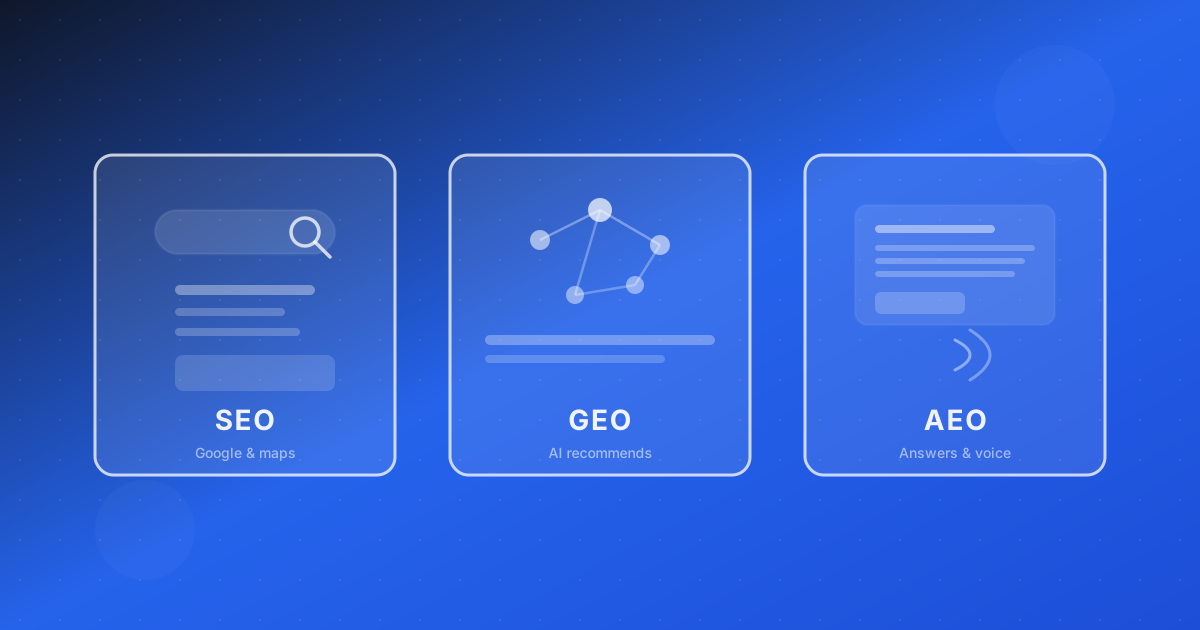
Your future clients are searching for legal help in three very different ways. Here's what SEO, GEO, and AEO actually mean for your firm — and why ignoring any one of them is costing you cases.
The way people find attorneys has changed
Five years ago, a potential client typed "divorce attorney near me" into Google, clicked one of the first few results, and called that firm. Simple.
Today, that same person might ask ChatGPT for a recommendation, read an AI-generated overview at the top of Google before clicking anything, or speak a question into their phone and expect a direct answer. The search landscape has fractured into three distinct channels, and most law firms are only visible in one of them — if that.
The three channels are SEO, GEO, and AEO. They sound similar, and they do overlap, but each one answers a fundamentally different question about how people discover your firm. Understanding the difference is no longer optional. It is the difference between a full pipeline and an empty phone.
SEO: Outrank your competitors on Google
Search Engine Optimization is the strategy most attorneys have at least heard of. The goal is straightforward: when someone searches for a legal service on Google, your firm appears above your competitors.
What success looks like: More organic traffic to your website. More clicks from search results. More calls from people who found you on page one.
What it takes in practice:
- Your website needs to load fast, be mobile-friendly, and be technically sound so Google can easily crawl and index every page.
- Your content should target the specific terms your prospective clients actually search for — not legal jargon, but the plain-language questions real people type into Google.
- Your Google Business Profile needs to be fully completed and actively maintained. This is what powers the map pack, the local results box that appears for searches like "personal injury lawyer in Dallas." Firms that treat their profile as an afterthought get buried.
- Reviews matter enormously. The number of reviews, the recency of reviews, and whether you respond to them all factor into how prominently Google displays your firm. A competitor with 200 recent five-star reviews will consistently outrank a firm with 12 reviews from 2022.
- Your broader online presence — directory listings, legal profiles, association memberships — builds trust signals that reinforce your authority.
SEO is the foundation. Without it, the other two strategies have nothing to build on. But SEO alone is no longer enough, because a growing share of your prospective clients never make it past the AI-generated answer at the top of the page.
GEO: Get recommended by AI search
Generative Engine Optimization is the newest of the three, and it addresses a shift that is reshaping legal marketing right now: AI-powered search tools that recommend specific firms by name.
When someone asks ChatGPT, Perplexity, or Google's AI search "Who is the best estate planning attorney in Phoenix?", the response is not a list of links. It is a curated recommendation. The AI reads hundreds of sources, synthesizes them, and names the firms it considers most relevant and credible.
What success looks like: How often your firm is the one being recommended. There is no "page one" in AI search — you are either mentioned or you are not.
What it takes in practice:
- Location-specific pages that clearly communicate your service areas. AI systems need explicit signals to understand where you practice. A single "Areas We Serve" page with a bulleted list is not enough. Each market you serve should have its own page with substantive content about the legal needs in that specific area.
- Consistency of your business information across every platform where your firm appears. If your address is slightly different on your website, your Google Business Profile, your Avvo listing, and your state bar directory, AI systems lose confidence about which information is correct — and they default to recommending a firm whose information is clean.
- Structured, factual content that AI can confidently cite. AI recommendation engines favor firms that present clear expertise signals: named attorneys, specific practice areas, geographic specificity, and verifiable credentials.
The firms winning in GEO are not doing anything exotic. They are simply making it unambiguous for AI systems to understand who they are, what they do, and where they do it.
AEO: Get your content featured in AI overviews and voice results
Answer Engine Optimization targets a specific outcome: having your firm's content appear directly in AI-generated overviews at the top of Google, in voice assistant responses, and in AI summary panels.
You have seen this yourself. Search for almost any legal question on Google and an AI Overview appears before the traditional results. It pulls sentences directly from web pages and presents them as a synthesized answer. The content it pulls from gets enormous visibility — often more than the first organic result — because many searchers never scroll past it.
What success looks like: How often your firm's content is featured in those AI overviews. How often your words are the ones being quoted.
What it takes in practice:
- FAQ sections on every service page. AI overviews pull heavily from well-structured question-and-answer content. Under your personal injury page, your family law page, your business litigation page — add a section of frequently asked questions with clear, concise answers. These answers should be written so that AI can extract them word-for-word and present them as a direct response.
- Content written in a Q&A cadence. Beyond formal FAQ blocks, structure your articles and blog posts so they naturally answer specific questions. Use the question as a heading, then answer it directly in the first sentence or two before elaborating.
- Technical accessibility for both Google and AI crawlers. This means clean HTML structure, proper heading hierarchy, schema markup where appropriate, and no barriers that would prevent automated systems from reading your content. If your site blocks crawlers, uses heavy JavaScript rendering without server-side alternatives, or buries content behind tabs and accordions, AI systems simply move on to a competitor whose content is easier to extract.
The attorneys who will dominate AEO are not the ones producing the most content. They are the ones producing the most extractable content — clear answers to the questions prospective clients are actually asking.
How the three work together
It helps to think of SEO, GEO, and AEO as three layers of the same visibility strategy, not as competing priorities.
| SEO | GEO | AEO | |
|---|---|---|---|
| Goal | Outrank competitors on Google | Get recommended by AI search | Get featured in AI overviews and voice results |
| Success metric | Organic traffic and search rankings | Frequency of AI recommendations | Frequency of content appearing in AI overviews |
| Key action | Optimize Google Business Profile, build reviews, strengthen online presence | Create location-specific pages, ensure business info consistency | Add FAQ sections, structure content for word-for-word extraction |
| Who sees it | Anyone searching Google | Anyone using AI-powered search | Anyone seeing Google AI Overviews or using voice assistants |
A firm that invests only in SEO will rank well in traditional results but get skipped by the AI overview that now appears above those results. A firm that only optimizes for AEO may get featured in AI panels but have no local visibility when someone searches on a map. And a firm that ignores GEO entirely may be invisible to the fastest-growing search channel of the decade.
The most effective approach is coordinated: a technically sound website (SEO) with clean, consistent information across all platforms (GEO) and well-structured, extractable content on every service page (AEO).
Why this matters right now
The shift from traditional search to AI-assisted search is not coming. It is here. Google's AI Overviews appear on the majority of informational legal queries. ChatGPT, Perplexity, and Copilot are fielding millions of queries about legal services every month. Voice assistants are the first point of contact for a growing segment of people looking for legal help.
Firms that build a coordinated visibility strategy across all three channels now will compound their authority over the next 12 to 24 months. Firms that wait will find themselves playing catch-up in a market that has already moved on.
Where to start
If your firm has not yet thought about GEO or AEO, start with an honest assessment of where you stand today.
- Audit your Google Business Profile. Is it complete? Are you actively generating and responding to reviews? Does your information match what appears on your website and legal directories?
- Check your business information consistency. Search your firm name and look at the address, phone number, and practice areas listed on every platform. Inconsistencies confuse both Google and AI systems.
- Look at your service pages through an AI's eyes. Could a machine extract a clear, direct answer to a common legal question from each page? If not, consider adding FAQ sections.
- Review your technical foundation. Is your site fast, mobile-friendly, and fully crawlable? Technical problems undermine every other investment you make in visibility.
This is not about chasing a trend. It is about ensuring that when someone in your market needs legal help and reaches for any search tool — traditional or AI-powered — your firm is the one they find.
LexGrow helps law firms build coordinated visibility across SEO, GEO, and AEO through purpose-built tools for the legal industry. Book a free visibility review to see where your firm stands today.