Most law firms spend months writing blog posts nobody ever reads. The problem is rarely the writing — it is the missing connections between pages. Here is why internal linking decides whether Google finds your content, and why most firms' blogs quietly disappear into search results they never show up in.
The blog posts nobody is reading
Walk into almost any law firm's website and you will find the same pattern: a blog with twenty, forty, sometimes a hundred posts. Posts about estate planning mistakes, personal injury settlement timelines, changes in family law, immigration policy updates. Each one took real time to write. Each one took real money, either in staff hours or in outside content fees.
And almost none of them are being found on Google.
You can check this for your own firm in under a minute. Open Google Search Console, look at the list of pages on your site, and sort by clicks. You will see a small handful of pages doing almost all the work, and a long list of blog posts with zero clicks, zero impressions, and zero rankings. They exist. Google barely knows they exist.
The most common reason is not the writing quality. It is not the topic choice. It is not even how often you post. It is the absence of internal linking — the invisible connective tissue that tells Google your blog posts are worth indexing, worth ranking, and worth sending traffic to.
This is the one SEO concept that almost no law firm gets right, and it has more influence on whether your blog actually works than any other single factor.
What internal linking actually is
An internal link is a link on your website that points to another page on your website. That is it. When your "Texas Child Custody Basics" blog post contains the sentence "If you are separating from a spouse, our divorce representation service can walk you through what to expect," that link is an internal link. It connects one page on your site to another page on your site.
External links — the ones pointing from other websites to yours — get most of the attention in SEO conversations. Internal links are less glamorous, but in many ways they matter more, because they are the part you fully control.
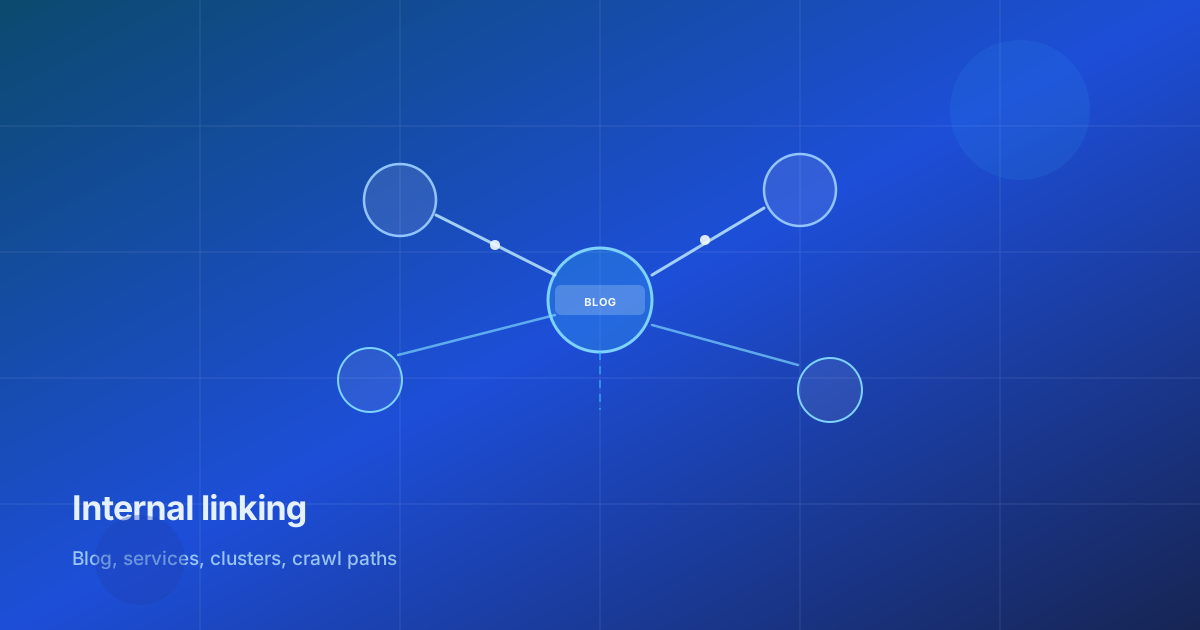
A well-linked website looks like a connected web of related pages. A poorly-linked website looks like a collection of isolated islands — each post floating alone, unreachable from anywhere else except a buried blog archive page.
Google treats those two websites very differently.
Why internal linking decides whether Google finds your blog posts
Three specific things happen when you link properly from one page to another on your own site.
Google discovers and indexes the page faster. Googlebot crawls the web by following links. When you publish a new post and link to it from your homepage, your main service pages, and related older posts, Google follows those links and finds the new post quickly. When a post has no internal links pointing to it, Google might not crawl it for weeks — and sometimes never indexes it at all. A blog post Google has not indexed cannot rank, no matter how good it is.
Google learns what the page is about. The text you use to link to a page — the "anchor text" — is one of the strongest signals Google has for what that page is about. If three different service pages on your site link to your estate planning blog post using the phrase "how to set up a living trust in Texas," Google receives a very clear signal that the post is the authority on that topic within your site. If no pages link to it at all, Google has nothing but the post itself to go on, and your ranking suffers accordingly.
Google distributes authority across your site. Every page on the web accumulates authority over time, through age, backlinks from other sites, and engagement. Internal links pass a portion of that authority from stronger pages to weaker ones. When your homepage links to a new blog post, some of your homepage's authority flows into the post. This is why firms whose blog posts link back and forth to the main service pages — and vice versa — see their entire site lift together, while firms with isolated posts see only their homepage rank.
Without internal linking, a new blog post is almost invisible to Google. With strong internal linking, the same post can start ranking within weeks.
What happens when internal linking is missing
Most law firm blogs fail in a predictable sequence.
- A post gets published. It lives at a URL nobody has ever linked to — not from the homepage, not from the services pages, not from older posts.
- Google eventually crawls it, but has no external signals suggesting it matters, and no internal signals either. It indexes the post with low confidence.
- The post does not rank for any meaningful search, because Google has no reason to prefer it over the thousands of other posts on similar topics published by firms that did link to theirs.
- The post gets buried on the blog archive page. Nobody on your site reaches it through navigation. Nobody from outside reaches it through search.
- Six months later, the post is effectively dead. The firm concludes "blogging does not work" and either stops, or keeps writing with the same missing ingredient.
This is not a rare failure mode. It is the default outcome for the vast majority of law firm blogs, and it is entirely caused by the absence of a basic internal linking practice.
What strong internal linking looks like for a law firm
There is no mystery to this. Firms whose blogs actually rank follow a simple, consistent pattern across every post.
Every new blog post links to at least two or three relevant service or practice area pages. A post about "what to expect in a Texas divorce" links to your divorce service page, your child custody service page, and your family law overview. A post about estate tax changes links to your estate planning service, your probate service, and your attorney bio if an individual lawyer at the firm is quoted.
Every new blog post links to at least two or three related older blog posts. If you have written about divorce, custody, and alimony before, your new post on any of those topics links to the older ones. This signals to Google that you have a content cluster — a group of related articles that reinforce each other — which Google consistently rewards.
Every relevant older blog post gets updated to link to the new post. This is the step almost everyone skips. When you publish a new piece, three or four of your existing related posts should be edited to add a link to it. A post that arrives with links already pointing at it from inside your own site ranks far faster than one that arrives in isolation.
Service and practice area pages link out to the blog posts that support them. Your "Personal Injury" service page should link to your strongest personal injury blog posts. This pushes authority from your most important pages down into your content, and helps both the service page and the blog post rank better.
Anchor text is descriptive, not generic. A link that reads "how child custody decisions are made in Texas" tells Google what the destination page is about. A link that reads "click here" or "read more" tells Google nothing.
Links are natural, not stuffed. Three to six well-placed internal links in a 1,500-word blog post is usually right. Thirty is spam. The goal is to connect your content meaningfully, not to game an algorithm.
That is the entire playbook. It is not complicated. It is just not what most firms do, because it requires someone to think about your website as a connected system every time a new post goes live — not just as a sequence of isolated pieces.
Why this is so hard to do consistently in-house
In theory, internal linking is simple. In practice, it is one of the first things that slips in any in-house content operation.
To do it properly, whoever writes each blog post needs to know the full catalog of your existing content — every service page, every practice area, every older blog post, every attorney bio, every local landing page. They need to remember what has been published on what topic, and make deliberate linking choices each time. They also need to go back and update older posts to link to the new one, which is the step that gets skipped almost every time a firm is busy.
Over a year of posting, that means dozens of decisions per month, hundreds of small updates to old posts, and an ever-growing awareness of how the whole site fits together. Most firms do the first three posts well, then quietly stop linking at all. The posts keep getting written, but the linking — the part that actually makes them rank — disappears.
This is why firms with thirty well-written blog posts often get no traffic from them. The posts are not broken. The connective tissue between them was never built.
How LexGrow takes blog posting — and internal linking — off your plate
LexGrow's content strategy pillar is built specifically to solve this problem. We do not just publish blog posts for your firm. We publish blog posts that are engineered, from the first draft, to actually rank — because every post is internally linked into the rest of your site as part of the standard process, not as an afterthought.
Before any sales conversation, we run two complimentary audits so our first call is grounded in your real data:
- A technical audit with PageSpeed scoring and specific, prioritized fixes across metadata, headings, crawlability, and structured data.
- A visibility audit covering keyword rankings, backlink profile, Moz brand authority, Google's AI overview appearances, and how often your firm is being cited by AI tools like ChatGPT and Perplexity.
On the first call, we walk through both audits, demo the live client dashboard, and review the full visibility checklist we track for every firm. If the fit is right, we move into onboarding. If not, the audits are yours to keep.
Once you come on board, our work is organized around four pillars — and content strategy, including internal linking, sits at the center of the operation.
- Technical SEO. Site speed, metadata, structural health, and crawlability, backed by a complete tracking foundation across Google Analytics, Google Search Console, and Bing Webmaster — so every post we publish is discoverable the moment it goes live.
- Search visibility. Keyword rankings and backlink profile, a Moz-based brand authority score, and how often your firm is being recommended inside AI-powered search like ChatGPT, Perplexity, and Google's AI overviews.
- Content strategy. Targeted keyword research, FAQ and Q&A content, and regionally focused blog posts engineered to rank on Google and be cited by AI answer engines — with internal linking built into every post from the first draft.
- Local and social presence. Active management of your Google Business Profile and Bing Places, plus steady, on-brand engagement across Reddit, Trustpilot, BBB, Nextdoor, Yelp, Facebook, LinkedIn, and the other platforms that build local credibility.
Every week, we work inside a single shared OneDrive workspace that holds your target keyword list, content plan, technical improvements plan, local presence plan, and credentials document. From there, we:
- Publish new blog content against the plan — AI-drafted, human-reviewed, and built around FAQ-style pages that get cited by AI. Every post includes a full set of internal links to the relevant service pages, practice area pages, and older related posts, with descriptive anchor text chosen to reinforce what each linked page ranks for. When a new post is published, we also go back into the most relevant older posts and add links forward to the new one, so the content cluster grows stronger with every addition.
- Post on Reddit and the social platforms that matter for your market, and promote the same content through your Google Business Profile and Bing Places.
- Walk the visibility checklist end to end and fix anything that has drifted since last week.
- Stand up or refresh one new local visibility platform each week — Trustpilot one week, BBB the next, then Nextdoor, Yelp, Facebook, and LinkedIn — until your firm has a complete, consistent presence everywhere a prospective client might look.
Every month, we run the deeper work: fresh technical and visibility audits tracked over time, a full analytics and keyword review with continued page-speed optimization, and a strategy call that sets the next month's priorities based on which keywords are slipping, which pages are due for a refresh, and which competitors are moving into your market.
The outcome is the one most firms never manage in-house: a growing library of blog posts that are not just written, but actually connected — so each one starts pulling its weight in search, and your whole site's visibility compounds as the library grows.
If your firm has a blog that is not earning the traffic you expected, the problem is almost certainly not the writing. It is the connective tissue that was never built. Book your free audit — we will run the technical and visibility audits on your firm and walk you through the findings on our first call, at no cost, whether or not we end up working together.